

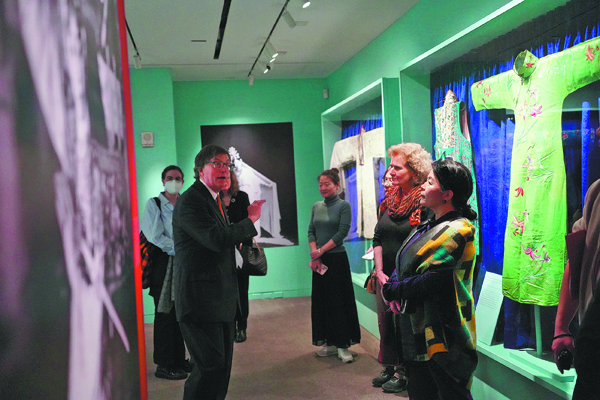
Visitors explore the exhibition The Dancing Goddess: Mei Lanfang in America at the gallery of the China Institute in New York. The exhibition, on view from March 12 to July 12, traces Mei's 1930 North American tour. [Photo by Mingmei Li/China Daily]
A golden helmet decorated with beaded strands and pom-poms, white silk embroidered with peacocks and peonies, and ancient costume charts in English and Chinese placed side by side, each item tells the story of a historic cultural encounter nearly a century ago.
At the China Institute Gallery in New York, The Dancing Goddess: Mei Lanfang in America revisits the legendary 1930 North American tour of Mei (1894-1961), which introduced Peking Opera to mainstream audiences in the United States.
On view from March 12 to July 12, the exhibition brings together stage costumes, rare photographs, archival footage and original performance props.
Most of the objects in the exhibition are on public view in the US for the first time, on loan from the Chinese National Academy of Arts in Beijing, the world's foremost archive of Mei Lanfang memorabilia, according to the China Institute of America.
The exhibits highlight the contributions of the Chinese opera master Mei, an artist who preserved tradition and embraced innovation in cultural and artistic exchange between China and the US.
The exhibition also explores how his visit to Broadway influenced and reshaped his presentation of Peking Opera through encounters between Eastern and Western cultures.
When Mei arrived in the US in 1930, few Americans had ever seen Peking Opera. His tour across major cities, including New York, Washington, Chicago, and San Francisco, sparked widespread curiosity about Chinese theater and culture.
His performances attracted packed theaters and extensive media coverage, inspiring conversations among artists, critics and intellectuals about new possibilities in theater and performance. The exhibition features archival newspapers and commentary from American critics, who described Mei's performances as both mysterious and mesmerizing, introducing audiences to an art form that blended singing, dance, and stylized acting in ways unfamiliar to Western theater.
"Mei's performance was an act of translation and adaptation," says Wang Kui, director of the Opera Research Institute at the Chinese National Academy of Arts.
Best known for portraying dan, or female roles, Mei combined elegant choreography with expressive acting, creating a theatrical language that resonated even with audiences who did not understand Chinese. His performances demonstrated that artistic expression could transcend linguistic and cultural barriers, Wang tells China Daily.
"Mei has become a cultural ambassador bridging the East and the West. He is an embodiment of beauty," Wang says. "Even after 100 years, the colors and aesthetics of his work have not diminished."
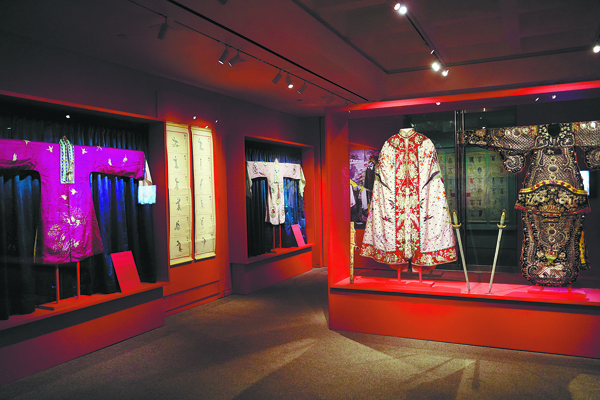
Exquisite stage costumes worn by Mei during his 1930 US tour are on display at the exhibition. [Photo by Mingmei Li/China Daily]
As the first director of the predecessor of the Chinese National Academy of Arts, Mei was not only an artist but also an educator. His legacy is preserved at the academy in an extensive and complete collection of documents and artifacts, many of which have been brought to the US for the exhibition.
"Many contemporary creators might hesitate to make such bold design choices. But Mei did; and his sense of style still resonates today,"Wang says. "This reflects his vision of beauty and his way of discovering and expressing it."
For example, Wang highlights that some costume designs show the influence of early Western stage lighting, including sequins and reflective details.
"The artistic exchanges of the 1930s left a lasting impact on both Eastern and Western theater," he adds.
"The Peking Opera art form evolved into a transcultural expression under Mei," says Catherine Yeh, curator of the exhibition and professor of Chinese literature and transcultural studies at Boston University.
"His performances drew inspiration from classical Western dance while maintaining their own distinctive style. The art form was crafted so that Western audiences could understand it and be emotionally moved by it, and it also made a significant impact on Western theater. This reflects a form of cultural exchange flowing from the East to the West — and back again."
To help American audiences understand the art form, performances were carefully designed and contextualized for years before the trip. For example, the exhibition also featured explanations of gestures and storylines in English; and certain elements of the staging were adjusted so viewers unfamiliar with the conventions of Peking Opera could better follow the narrative and appreciate the performance.
In addition to the costumes and props required for stage performances, Mei also brought detailed illustrations of traditional Chinese musical instruments during his overseas tours.
"There were numerous drawings of instruments, far more than would typically be used in a Peking Opera orchestra. He wanted to introduce Western audiences to the broader musical system behind Chinese opera," Shao Xiaojie, deputy director of the library at the Chinese National Academy of Arts, tells China Daily.
"There were no recording devices at the time, so musicians had to repeatedly play and sing the melodies to 'transcribe' the music," Shao explains.
She adds that another challenge in translating Chinese notation into Western notation was the fundamental difference between the systems: Chinese notation records fingering techniques and structural rules rather than precise pitches, as some elements, such as vocal inflection, rhythm, and expressive phrasing, cannot be fully captured on paper. Western notation, by contrast, is more precise and standardized. Translating Chinese opera music into Western staff notation was therefore not a simple matter of copying symbols, but required extensive preparation by Mei and composer Liu Tianhua.
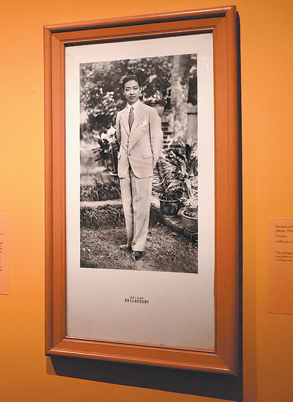
A historic photo of Mei, the renowned Peking Opera performer. [Photo by Mingmei Li/China Daily]
Mei's 1930 tour also played an important role in shaping the mission of the China Institute of America, which organized the trip and collaborated with Mei's team to translate many of the documents for American audiences, an early example of cultural "localization".
Nearly a century later, that goal remains central to the institute's work, says Charles A. Riley II, director of the China Institute Gallery.
"We want to teach the world about Chinese culture, especially so that children can learn the beautiful stories of Mei and his performances,"Riley says. In the long history of illustrious Broadway shows, Mei Lanfang's American debut was an unexpected smash hit that created unprecedented, wide-ranging diplomatic benefits."
By revisiting Mei's historic journey, the exhibition highlights how artistic exchange, once sparked by a traveling opera troupe, continues to shape cross-cultural dialogue today, says Qi Yonggang, the deputy director of the Chinese National Academy of Arts.
"Mei's 1930 tour raised his profile and introduced Peking Opera to American audiences. Through this exhibition, we hope to showcase China's traditional performing arts and help more local audiences appreciate the richness of our cultural heritage," Qi says. "As early as 1930, cultural exchange between China and the US was thriving. Mei's tour provides a concrete example of how such exchanges can build understanding across cultures. This process continues today."
In recent years, with the growing popularity of "China travel", many American visitors have embraced cultural experiences, such as wearing Peking Opera costumes.
"Mei's trip set a model for cultural exchanges. We also want more children to go to China, and experience and explore Peking Opera firsthand," Qi adds.
 Editor:Cai Xiaohui

